
Worcester Projected Versus Actual Release
A projected date is a working sentence calculation. An actual release date records when the custodian carried out the release or transfer. Massachusetts uses several related terms, including maximum release date, Release to Supervision Date, parole eligibility date, earliest projected discharge date, and actual release date. They are not interchangeable.
The DOC glossary describes a release date as a date calculated from the sentence terms before later earned deductions and used as the basis for the actual date. Release to Supervision, or RTS, is a credit-reduced maximum date under a separate statute. Parole eligibility merely opens a Board process. A favorable parole vote may still require a suitable plan and other conditions before the institution executes release.
Scheduled versus actual: A calculation forecasts one legal milestone. Only the final correctional release entry or certificate confirms the completed exit.
A pretrial WCSO detainee has no sentence-based projected date. Bail, personal recognizance, a court order, dismissal, or later sentencing controls the path. Even a sentenced person’s exit from one agency can be a transfer to DOC, another county, federal custody, immigration custody, or a warrant rather than release to the community.
Find Worcester Inmate Release Dates
Start with the last known custodian. WCSO holds county jail and house-of-correction records. Massachusetts DOC holds NCCI, SBCC, and other state-prison calculations. BOP holds federal sentence data. These agencies do not share one Worcester County projected release-date search.
- Determine whether the person is pretrial, serving a county sentence, serving a state sentence, or serving a federal sentence.
- Read the judgment and mittimus for the sentence length, minimum and maximum terms, start date, and concurrent or consecutive structure.
- For WCSO custody, contact Records and request the existing house-of-correction computation or release entry. Check the sentencing court for later orders.
- For DOC custody, use the public locator only for present DOC information, then request the named calculation or discharge record from DOC.
- For federal custody, use BOP while recognizing that its projected dates can change and apply only to BOP custody.
- Check parole, warrants, detainers, civil commitments, and receiving-agency records before treating one sentence end as freedom from all custody.
- Obtain the actual release entry or certificate after the event.
The Worcester County released-inmate record path identifies the correct records office and explains why disappearance from a live roster does not prove release. Use the date’s “as of” point whenever a custodian supplies a calculation.
No Public DOC Projected Date
The official Massachusetts prison locator instructions route the public to VINELink for someone being held. They require a full first and last name or commitment number and state that only Massachusetts DOC participates. The page does not document a released archive, actual release date, projected date, earliest date, offense, parole office, or supervision status.
The official locator route can be reviewed directly before beginning a DOC search.
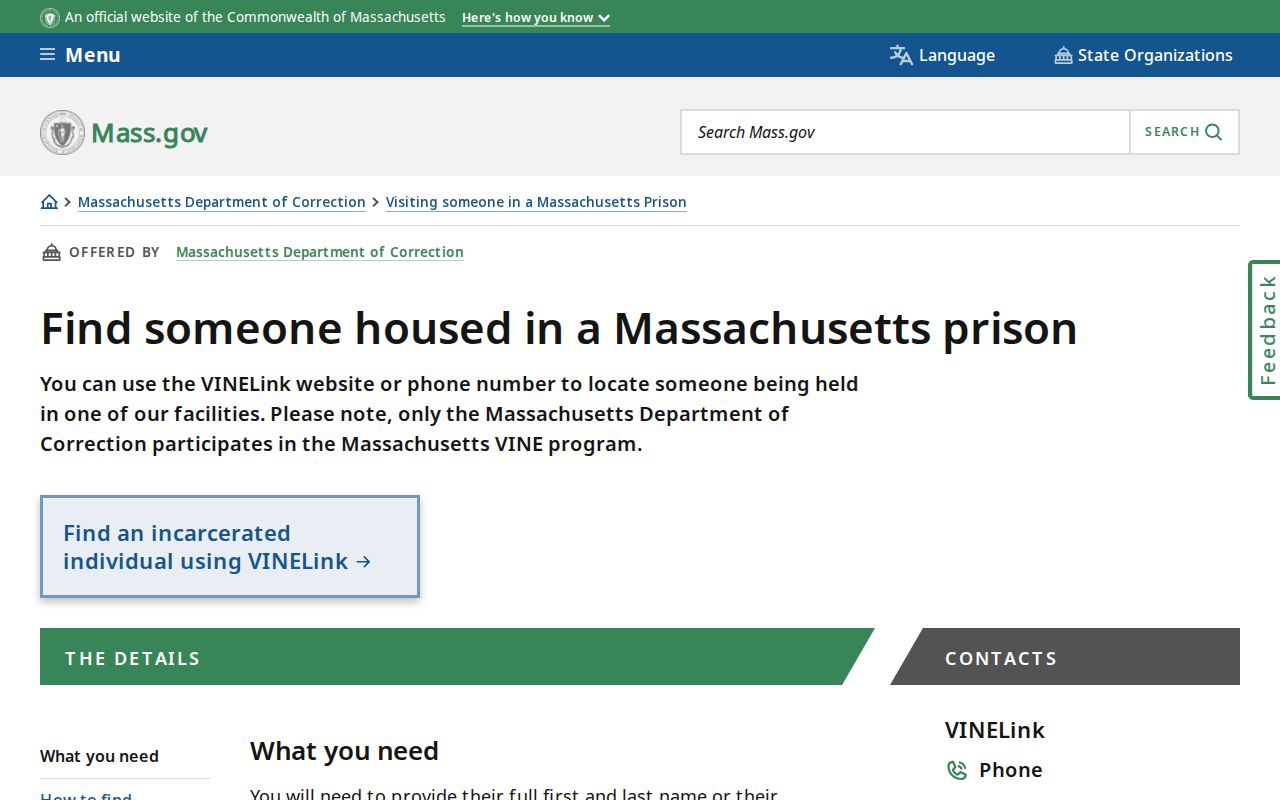
The image confirms the DOC custody-search route but does not establish a public projected-release field.
If a person disappears from VINELink, do not assign an actual release date. The result may reflect a spelling or identifier problem, scope, timing, or a transfer. Request the discharge entry, certificate, actual date and type, destination, and releasable sentence-computation fields from the DOC Records Access Officer. DOC lists an online form, doc.rao@state.ma.us, 508-422-3436, and 50 Maple Street, Milford, MA 01757.
DOC does not process county jail or house-of-correction requests. Those belong with WCSO. This agency boundary is essential when a Worcester County case moves from the local house of correction to a state prison.
Worcester Release Credit Rules
Massachusetts does not have a universal rule requiring every prisoner to serve 85 percent of a sentence. The state’s old general good-time statute was repealed. Current law allows specific earned program, activity, camp, and completion credits, subject to eligibility, caps, the sentence, exclusions, and actual award.
For a state-prison sentence, M.G.L. c. 127, § 129D permits up to 7.5 days per qualifying program or activity each month, capped at 15 days monthly. It also permits designated completion awards, including up to 10 additional days and up to 80 days for designated successful completion. Aggregate completion credits under the stated subsection cannot exceed 17.5 percent of the imposed maximum, and combined reductions are subject to the statute’s 35 percent ceilings.
For a house-of-correction sentence, § 129D permits up to 5 days per qualifying program or activity, capped at 10 days per month. The extra completion award has its own conditions. Credits require satisfactory participation or completion and shown competence. Time spent confined by itself does not earn every possible credit.
Other rules also matter. Section 129B credits qualifying confinement awaiting trial unless it was already deducted. Section 129C authorizes certain prison-camp credit. The institution must still resolve overlapping or consecutive terms, disciplinary forfeiture or restoration, and later court changes.
The state’s earned-time statute can be examined at its official source.
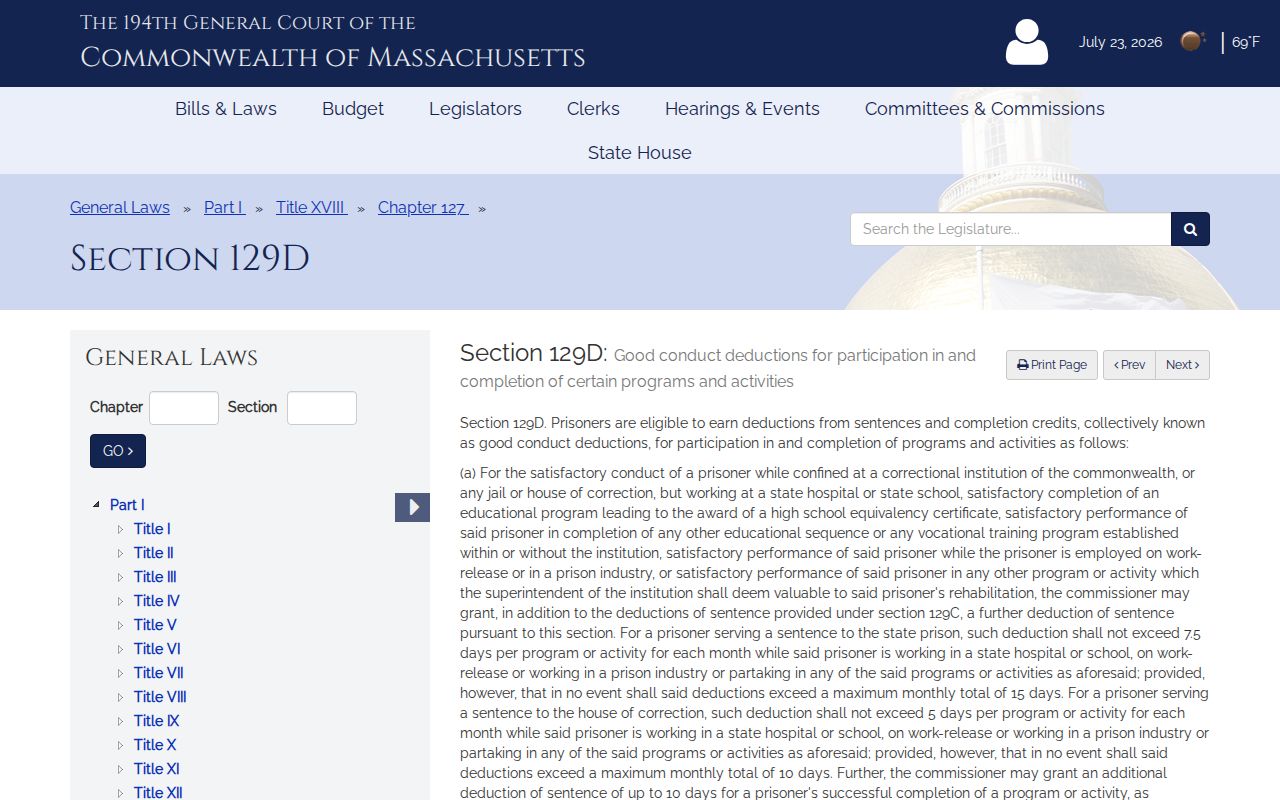
The statute’s separate rates and caps show why a generic good-time calculator cannot confirm a Worcester County release date.
Note: Apply only credits actually awarded under the sentence and program rules; a theoretical maximum is not a confirmed release calculation.
Worcester Release to Supervision
M.G.L. c. 127, § 130B establishes Release to Supervision from the maximum term reduced by qualifying credits. The date cannot be earlier than the result of the statute’s 35 percent maximum reduction. That creates a 65 percent floor within the RTS mechanism, not a universal 85 percent rule.
RTS also depends on qualifying completion credits and an approved parole plan and does not override mandatory-minimum periods. Habitual-offender and other statutory exclusions apply. A person released through RTS remains on parole supervision for the rest of the sentence. The RTS date is therefore neither final sentence discharge nor proof that the institution has already opened the gate.
The official RTS calculation and limits are set out in the statute.
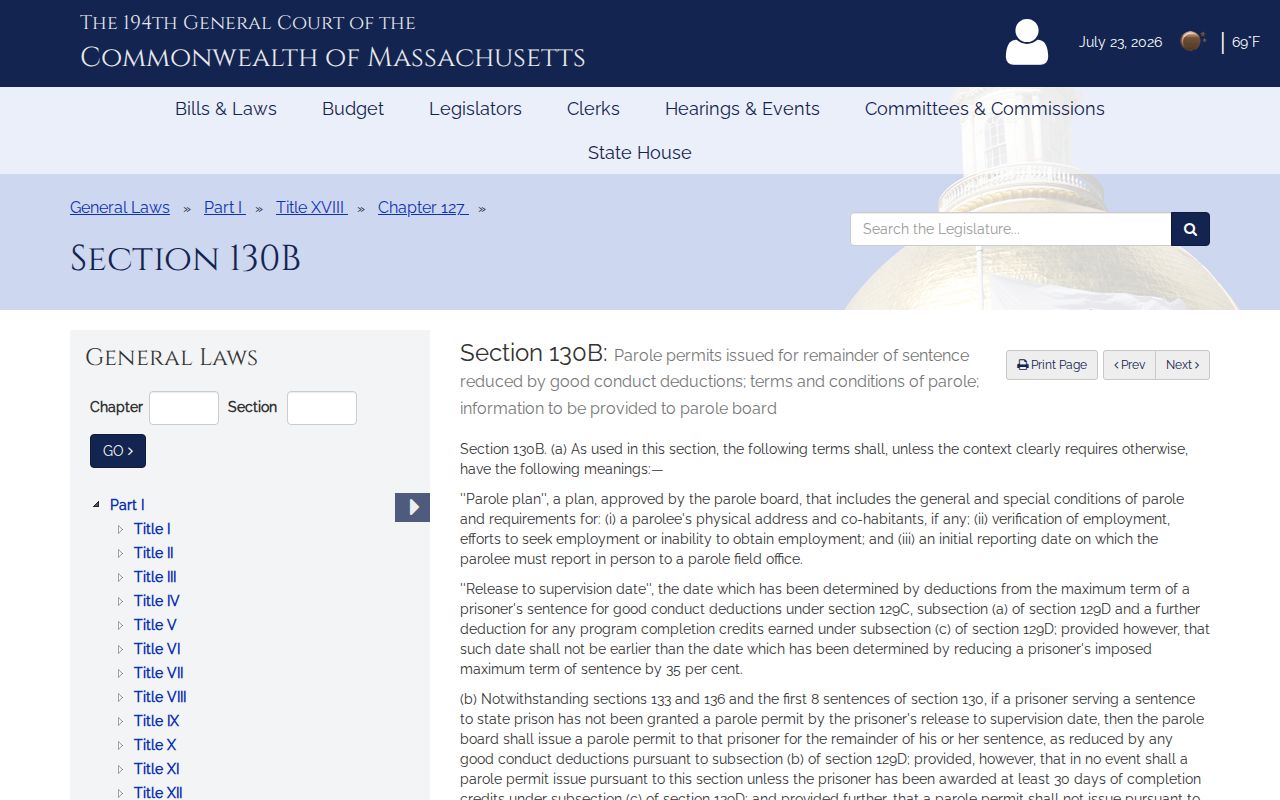
The statutory text supports the credit-reduced RTS concept while preserving its eligibility and plan limits.
Why Worcester Release Dates Change
A sentence calculation is a record of the facts known and credits posted at a given time. New information can move it. Some changes affect the end of the sentence. Others change only the place or legal status to which the person is released.
| Factor | Effect on the date or exit |
|---|---|
| Earned credits | Qualifying credits actually awarded may reduce the computed date within statutory limits. |
| Discipline | Forfeiture or later restoration can move a prior calculation. |
| Court amendment | A corrected judgment, credit order, or new consecutive sentence changes the inputs. |
| Escape or warrant time | Time not credited can extend the controlling calculation. |
| Parole or RTS | May end physical confinement before maximum discharge while supervision continues. |
| Detainer or civil hold | The person may leave one sentence and enter another custody status. |
| Release-order review | DOC checks warrants, discipline, credits, and sentence listings before issuing the certificate. |
Federal dates require extra caution. BOP warns that recalculations under federal law can change projected dates. A past BOP release date or “Released” status applies to BOP custody and does not rule out supervised release or another agency’s custody.
Worcester Weekend Release Rules
For an ordinary term, M.G.L. c. 127, § 150 moves a Saturday, Sunday, or legal-holiday expiration to the preceding day. A Friday Worcester County release can therefore be the legally adjusted final discharge of a sentence that appears to end over the weekend.
That rule must not be confused with a court-ordered intermittent sentence under M.G.L. c. 279, § 6A. For an eligible first offense with a jail or house-of-correction term within the statute, the court can order weekends or other intervals. Unless the court orders otherwise, the person reports Friday evening and leaves Monday morning, or Tuesday morning after a Monday holiday, until the imposed time is served.
A Friday event can thus mean final discharge in one Worcester County case and the start of another weekend custody interval in the next. The judgment, mittimus, and release entry resolve which event occurred. Calendar assumptions do not.
Note: The preceding-day rule applies to an ordinary term’s expiration, while an intermittent sentence follows the court’s recurring custody schedule.
Worcester DOC Tablet Timelines
DOC’s 2026 tablet initiative gives incarcerated people updated maximum-release and RTS timelines. The public locator promises neither field. This is an important asymmetry in Massachusetts: a person inside DOC may see a current institutional timeline that family or supporters cannot independently retrieve through the public VINELink path.
A date relayed from the tablet can be meaningful, especially when paired with its label and “as of” date. It remains a projection. Credits, forfeitures, warrants, court changes, sentence structure, and release-order review may alter it. Ask whether the displayed number is the maximum release date, RTS date, parole eligibility date, or another date before comparing it with a record.
The DOC tablet announcement documents the internal access. It does not convert the public locator into a projected-date database. The final release record is still required to establish that the person left.
Confirm Worcester Release Dates
DOC regulations describe an institutional review before release. Ordinary release orders are prepared in advance of the earliest projected discharge date, with a longer lead for identified sex-offender orders. Staff review sentence listings, warrants, discipline, forfeiture and restoration, and earned-time data before approval and issuance of the certificate. The certificate, not an outside calculation, is the final institutional document.
For a pending DOC event, the Worcester County VINELink release check may provide an alert option for the matched DOC record. Massachusetts VINE is DOC-only, has no documented public projected-date field, and does not cover WCSO or federal custody. An alert should be matched to the agency’s record.
For WCSO, ask Records or the sheriff’s Records Access Officer for the existing computation and later release entry. For DOC, request the named calculated date, its “as of” date, and the later discharge certificate. For BOP, preserve the locator result and use federal records when more detail is needed. In all three systems, check the court, parole, and receiving authority before calling the date a release to the community.
Keep each source dated, labeled, and tied to the correct custodian. A newer signed order or correctional certificate should be reconciled with any earlier estimate before the release date is treated as final.