
Worcester Parole Versus Probation
Parole and probation can both place a person under rules in the community, but their legal roots differ. Worcester County parole begins only after release from a committed sentence under Massachusetts Parole Board jurisdiction. Probation is imposed by a judge and supervised through the Massachusetts Trial Court. It can be the main sentence or can start after jail or prison time ends. A WCSO release entry may name parole as the release type, but the sheriff is not the custodian of either the parole permit or the probation order.
The distinction controls where to verify the status. A parole decision, permit, supervision record, or discharge belongs with the Parole Board. A probation term is established by the docket, judgment, and probation order in the sentencing court. Worcester District Court serves Auburn, Millbury, and Worcester, while other communities use other District Court divisions. Serious felony matters may be filed in Worcester Superior Court.
| Question | Parole | Probation |
|---|---|---|
| Source of authority | Massachusetts Parole Board decision and permit | Trial Court judgment or probation order |
| When it begins | After release from a committed sentence | As the sentence or after confinement |
| Local route | Region 4 or Parole Board records | Sentencing court clerk or probation department |
| Public name lookup | No statewide public parolee search | Use the permitted court docket route or clerk |
| Ending record | Parole termination or discharge record | Court record showing completion or termination |
- Parole
- Conditional community supervision after release from a committed sentence.
- Probation
- Court-ordered supervision that may replace or follow confinement.
- Discharge
- The formal end of custody or supervision under the controlling authority.
- Absconder
- A status supported by an agency record that a supervised person has failed to remain under supervision.
Verify Worcester Post-Release Supervision
Begin with the document that explains the exit from custody. The Worcester County released-inmate search and records path separates a true community release from a transfer to DOC, another court, federal custody, or immigration custody. If the release entry says parole, follow the Parole Board route. If the docket says probation, stay with the sentencing court. Do not assume one status because the other appears more likely.
- Identify the last custodian and obtain the release type or court disposition. A person missing from the WCSO roster is not automatically on supervision.
- For parole, check the Board’s public decision collection when it applies. A favorable decision is not the same as an executed release.
- For probation, locate the correct Trial Court division and review the judgment or probation order through permitted public access.
- Contact Region 4 only when it is the likely supervising region. Its public office page is a routing resource, not a client directory.
- Request a specific releasable record from the Parole Board or court when the online material does not establish the current status.
- Match any supervision record with the correctional release entry and the person’s identity before drawing a conclusion.
MassCourts remote access for criminal cases is narrower than access for many civil matters. If an exact criminal case cannot be reached remotely, the clerk or a courthouse public terminal may be needed. A failed name search does not prove there is no probation case, especially when the municipality is served by another Worcester County court division.
Important: Massachusetts has no open statewide parolee name locator. A contact office, hearing calendar, or old decision does not establish current supervision.
Worcester Parole Hearing Records
The Massachusetts Parole Board hearing hub links public life-sentence calendars, life-sentence decisions, and termination-request proceedings. These sources answer different questions. A calendar entry shows a planned proceeding. A decision may grant parole subject to conditions, deny it, or continue the matter. A termination hearing concerns the possible end of supervision, not the date the person first left prison.
The Board publishes life-sentence records of decision by year. Read the complete decision and its date. Massachusetts law makes the Board’s final decision and reasons public under M.G.L. c. 127, § 130, subject to the treatment of other case material. Ordinary institutional hearings do not appear in one complete, public, name-searchable calendar, so a focused Board records request may be the only sound route for a particular person.
The official decisions collection can be reviewed before asking for a nonpublic case file.
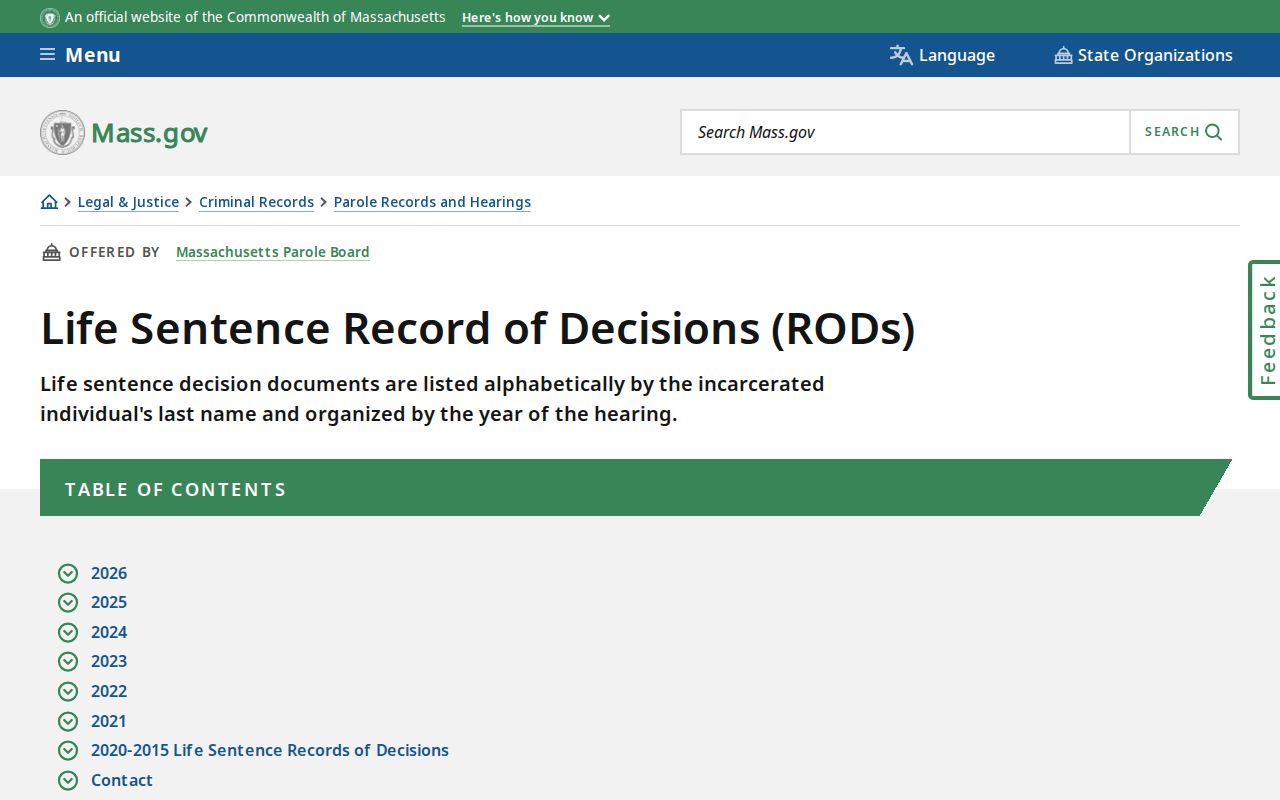
The image shows the public decision channel, not a list of everyone released on parole in Worcester County.
Eligibility also must be kept separate from release. M.G.L. c. 127, §§ 133 and 133A govern major parole-eligibility paths, while M.G.L. c. 279, § 24 can affect a county jail or house-of-correction sentence. An eligibility date opens a process. Actual release still depends on the decision, required conditions, an approved plan where applicable, and the correctional institution’s release action.
Worcester Parole Region 4
Massachusetts Parole Region 4 maintains the Worcester field office named in the state’s official location directory. That office is a practical route for questions about which regional office may supervise a Worcester-area parole case. It does not publish a client-name search. Staff may route a request, explain which records process applies, or require authorization when a record contains protected information.
10 Mechanic Street, 2nd Floor
Worcester, MA 01608
508-875-0621
Monday through Friday, 9:00 a.m. to 5:00 p.m.
The official Region 4 page is the source for the Worcester office details.
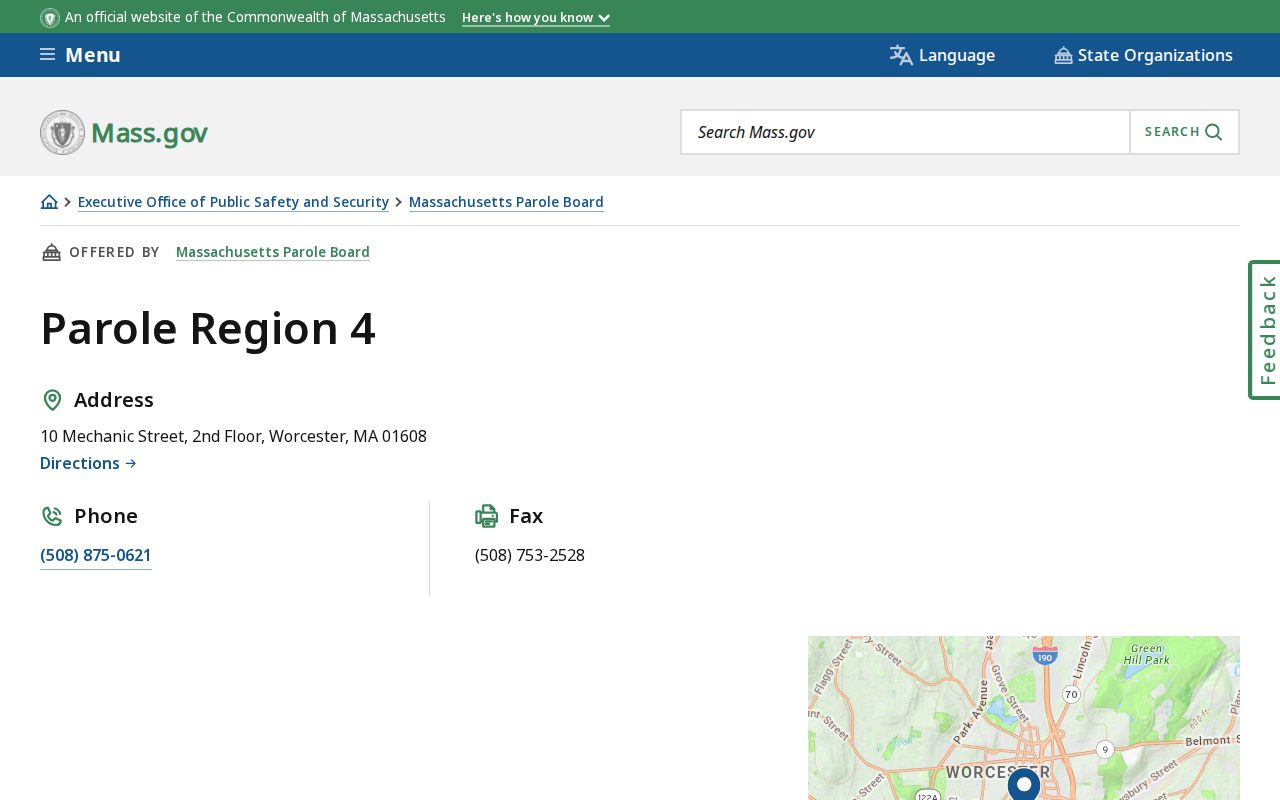
The office listing supports direct routing, but it must not be treated as evidence that a named person reports there.
For a decision or releasable supervision record, use the Board’s Records Access Officer at Parole records and hearings. The published route is par.rao@state.ma.us, 508-650-4500, or Records Access Officer, Massachusetts Parole Board, 12 Mercer Road, Natick, MA 01760. Describe the exact decision, permit, assumption-of-supervision record, or discharge sought. A narrow request is easier to process than a demand for an entire parole file.
Note: Region 4 may route an inquiry, but only the relevant record can establish a person’s parole status and dates.
Worcester Probation Court Records
Probation verification starts with the sentencing court, not with Region 4. The docket can show the sentence, term of probation, later modifications, alleged violations, and an order ending the term. The probation department may hold operational details, while the clerk maintains the court record. Public access can be limited by sealing, impoundment, juvenile rules, victim-information protections, and other lawful restrictions.
Worcester District Court lists a shared clerk and Probation Department public number of 508-831-2010. It serves Auburn, Millbury, and Worcester. A person sentenced in Fitchburg, Gardner, Leominster, Milford, Uxbridge, or another community may belong to a different division. Identify the docket and municipality before calling. Worcester Superior Court is the likely route for appropriate serious felony cases.
A court disposition may say that probation follows time served or begins after a committed term. That does not mean the live WCSO roster will display the supervision. The jail’s role ends when physical custody ends or transfers. The court record remains the key source for the probation order.
Worcester Supervision Violations
A violation does not have one automatic result. The Massachusetts Parole Board’s Field Services Division includes a Warrant Apprehension Unit, and an alleged violation can lead to return to custody and preliminary or final revocation proceedings. Probation violations proceed through the court. In either system, the alleged conduct, notice, hearing, and final order are distinct events.
Do not label someone an absconder because calls go unanswered, an old article uses the term, or a locator no longer returns a result. “Absconder” is an agency status and needs a current warrant, Board, or court record. If custody resumes, identify whether the person is held by WCSO, DOC, another county, or a federal agency. The supervising authority and the current custodian may not be the same office.
Massachusetts parole supervision information describes field services and the warrant function at a high level. It does not expose a public warrant or absconder search. Court and Board records remain the proper channels for a named status.
Note: An arrest on a supervision warrant starts a new custody event; it does not erase the earlier Worcester County release record.
Worcester Parole Release Alerts
VINELink is not a statewide parolee locator. Massachusetts’ official channel says only Massachusetts DOC participates in the Massachusetts VINE program. It may help follow a specific person while DOC holds that person and may offer notification options, but it does not establish that WCSO, county probation, or the Parole Board feeds a public Worcester County supervision list.
The Massachusetts Victim Notification Registry is separate. Eligible victims and family members may register through the formal DOC and Parole process for notices governed by that program. Certified notification is not an open public search. For a general, specific-person check, confirm the correctional event first and then use the record custodian tied to parole or probation.
Worcester Supervision Discharge
Physical release and supervision discharge occur at different points. A person paroled from a Massachusetts prison may live in the community while the committed sentence and Board jurisdiction continue. A later termination or discharge record marks the end of parole. Probation likewise ends through the court’s term and orders, not because a jail search no longer displays the person.
For parole, ask for the final decision, executed release information, assumption of supervision, and later termination or discharge record that fits the question. For probation, use the judgment, docket entries, and any order ending or modifying supervision. When the date matters, record each stage separately: eligibility, decision, physical release, supervision start, and supervision end.
A person may also leave one institution for a detainer, another prison, federal custody, or immigration custody. That is a custody handoff, even when the releasing institution calls its own event a release. Matching the correctional record to the Board or court record prevents a transfer from being mistaken for community supervision.