
SBCC Lancaster Custody Scope
SBCC is a Massachusetts DOC maximum-security institution and reception center for newly incarcerated men. It is not a Worcester County jail. Its intake, classification, transfer, parole, and discharge records belong to DOC, with court and Parole Board records supplying the legal context.
SBCC Transfers Versus Releases
Souza-Baranowski Correctional Center’s reception and diagnostic work makes transfers central to any search. Newly incarcerated men can enter SBCC, undergo classification, and move to another DOC institution. That move ends the SBCC placement but not the prison sentence. A current location elsewhere in DOC is proof that custody continued.
A true release from DOC may occur through parole, sentence expiration, discharge, or a handoff to another authority. Even then, “released” describes DOC’s segment. A parole permit can direct community supervision or another approved placement. A warrant or detainer may lead to new custody. Ask for the actual release type and destination.
| SBCC departure | Meaning | Confirmation |
|---|---|---|
| Classification transfer | DOC confinement continues at another prison | DOC location or movement record |
| Parole | Conditional release under Board authority | Parole permit and DOC release entry |
| Expiration/discharge | The controlling prison term ends | Certificate of discharge and court file |
| Other authority | DOC custody ends, later custody may start | Destination and receiving-agency record |
SBCC Lancaster Location Records
SBCC’s physical address is 1671 Shirley Road, Lancaster, Massachusetts 01523. Its mailing address is Harvard Road, P.O. Box 8000, Shirley, Massachusetts 01464. The physical address places the active institution in Worcester County even though mail uses Shirley. The shared campus geography does not make MCI-Shirley a Worcester County facility.
The official SBCC location page confirms the Lancaster physical site, Shirley mailing address, telephone, maximum-security role, and reception function. Review that source before the captured facility detail.
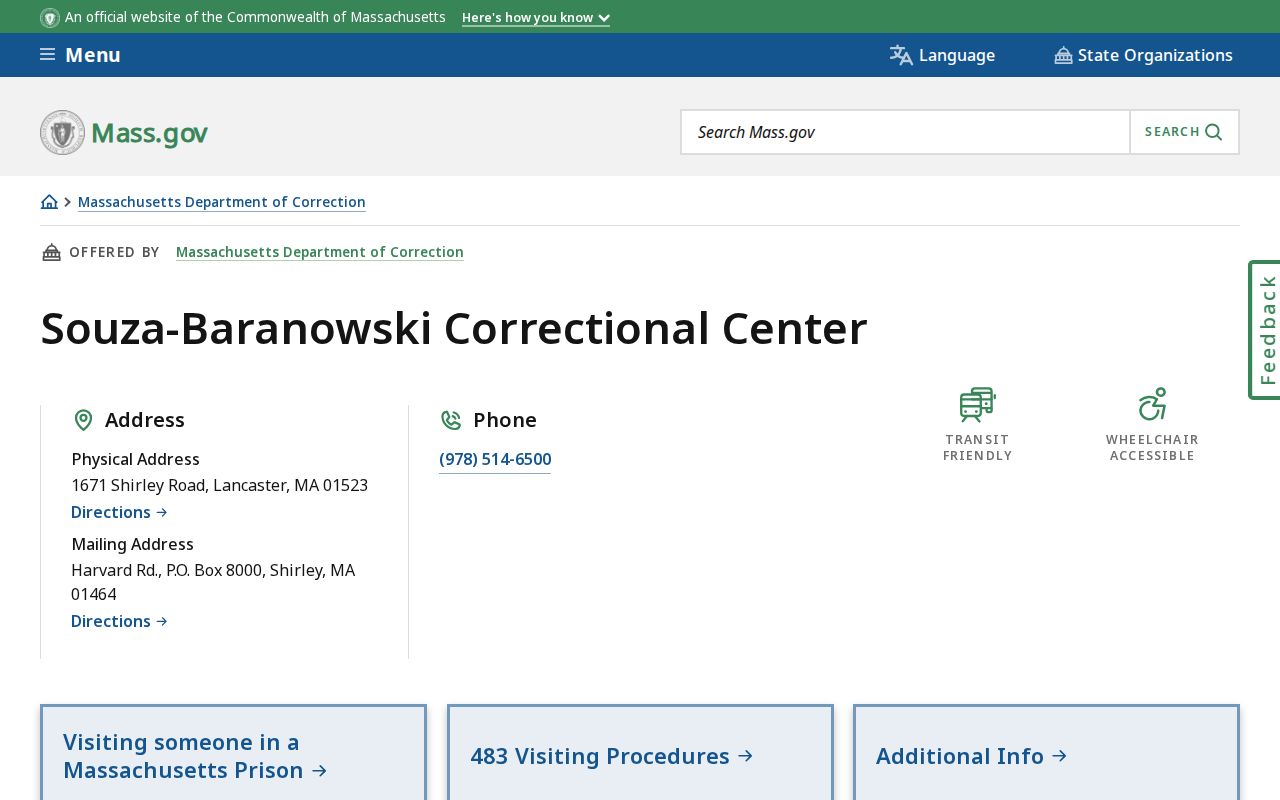
The captured source resolves the county-location issue. It also shows why a researcher must not switch to WCSO merely because SBCC is physically in Worcester County.
Search Current SBCC Lancaster Custody
Massachusetts DOC’s official locator instructions route to VINELink. Search by full first and last name or commitment number. The state says only Massachusetts DOC participates in the Massachusetts VINE program. The wording concerns someone being held, not a permanent historical discharge archive.
A returned DOC location can show that a person moved from SBCC to another institution. An absent result does not prove discharge. The official page promises no released status archive, actual or projected release date, offense, photograph, parole office, or supervision field. Use the locator to test current custody, then turn to records.
- Search exact name and commitment number through the official DOC route.
- Read the returned institution, not merely whether SBCC is absent.
- Review the sentencing docket for the controlling sentence and later orders.
- Check parole records when conditional release may apply.
- Request the DOC movement or discharge entry, release type, date, and destination.
The Worcester County release search shows how DOC records differ from WCSO, BOP, and ICE sources.
Request SBCC Lancaster Release Records
Massachusetts DOC’s Public Records Access Officer handles SBCC records. Use the online request form, email doc.rao@state.ma.us, call 508-422-3436, or write to 50 Maple Street, Milford, MA 01757. WCSO does not process state-prison requests.
Include the person’s name, commitment number, SBCC, and a narrow date range. If transfer is possible, ask for the movement record and destination institution. For a true release, ask for the face sheet or release entry, certificate of discharge, actual release date and type, destination, releasable sentence-computation material, and relevant mittimus. DOC can redact valid exemptions and need not create a custom explanation.
50 Maple Street
Milford, MA 01757
doc.rao@state.ma.us
508-422-3436
A written Massachusetts public-records response is generally due within ten business days. Ask for electronic copies, segregable non-exempt portions, and an itemized good-faith fee estimate. The first four hours of qualifying state-agency labor are generally not charged; later labor is generally capped by the statutory rules described in the state guide.
SBCC Parole Release Confirmation
A Parole Board decision and an executed release are different events. Institutional hearings can address release, rescission, or revocation. An approved outcome may direct release to community supervision, another state, federal custody, ICE, DOC, or a house of correction. Eligibility alone is not release, and the hearing date need not be the physical departure date.
Public life-sentence decisions are searchable by year and last name. There is no general public statewide parolee name locator. For other individual material, request releasable Board records and expect authorization or redaction where required. Confirm the SBCC release entry and parole permit together.
- Reception
- The DOC intake and classification process for a new prison admission.
- Transfer
- A move within or between authorities that may continue custody.
- Parole
- Conditional release under Parole Board authority.
- Discharge
- Formal completion of the controlling custody or sentence term.
Note: A new institution in the DOC locator resolves an SBCC departure as a transfer, not a community discharge.
SBCC Lancaster Records and Contact
The published SBCC telephone is 978-514-6500. Use 1671 Shirley Road, Lancaster, MA 01523 for the physical facility and Harvard Road, P.O. Box 8000, Shirley, MA 01464 for mail. The operator is the Massachusetts Department of Correction.
Physical: 1671 Shirley Road, Lancaster, MA 01523
Mail: Harvard Road, P.O. Box 8000, Shirley, MA 01464
978-514-6500
Massachusetts DOC
Call the institution for current operational routing. Use DOC’s records officer for documentary proof. No official public SBCC release gate, family waiting area, or routine discharge time was documented, so do not infer those details from the mailing address or reception role.
SBCC Release Court Records
The sentencing court supplies the legal term that DOC executes. Its file may show sentence length, credits, concurrent or consecutive terms, later orders, and disposition. DOC supplies the physical movement or release event. The Parole Board supplies conditional-release decisions and permits. Matching all applicable records prevents a classification transfer from being described as discharge.
If DOC’s destination names federal custody, ICE, another state, a house of correction, or another authority, follow that named custodian. A handoff closes the SBCC or DOC segment but does not prove freedom. Final confirmation must state both what ended and what began.
SBCC’s reception function also makes dates easy to misread. An admission date at the next prison may closely follow the date a person left Lancaster. Read the destination institution and commitment number across both records. When they match, the two dates describe one continuous DOC sentence, not a release followed by a new arrest. Only the formal discharge or parole record establishes the end of the state-prison custody segment.
Verify an SBCC Release Event
Build the record in chronological order. First, save the DOC locator result if it still identifies SBCC or another institution. Second, obtain the sentencing docket and exact commitment information. Third, request the DOC movement or release entry with its date, type, and destination. Fourth, add the Parole Board decision and permit when conditional release is involved. Each source answers a different part of the event.
A future maximum or supervision date is not an executed release. Credits may be earned or forfeited, sentence terms can interact, court orders can change, and warrants or detainers can redirect the exit. Massachusetts has no universal 85 percent rule. Section 129D earned deductions, section 129B presentence credit, and section 130B Release to Supervision operate under distinct rules. Use the actual SBCC or DOC release entry after the date passes.
Weekend timing can also affect an ordinary sentence. Under M.G.L. c. 127, § 150, a term that expires on a Saturday, Sunday, or legal holiday ends on the preceding day. A Friday discharge is not always discretionary. Record the release category before describing why the person left.
When the destination is another DOC prison, both movement records should carry the same person and commitment identity. When the destination is parole, another authority, or the community, the discharge or parole paperwork should say so. This comparison guards against the most common SBCC error: describing reception or classification movement as freedom from Massachusetts custody.